
Daily Skincare Routine for Psoriasis
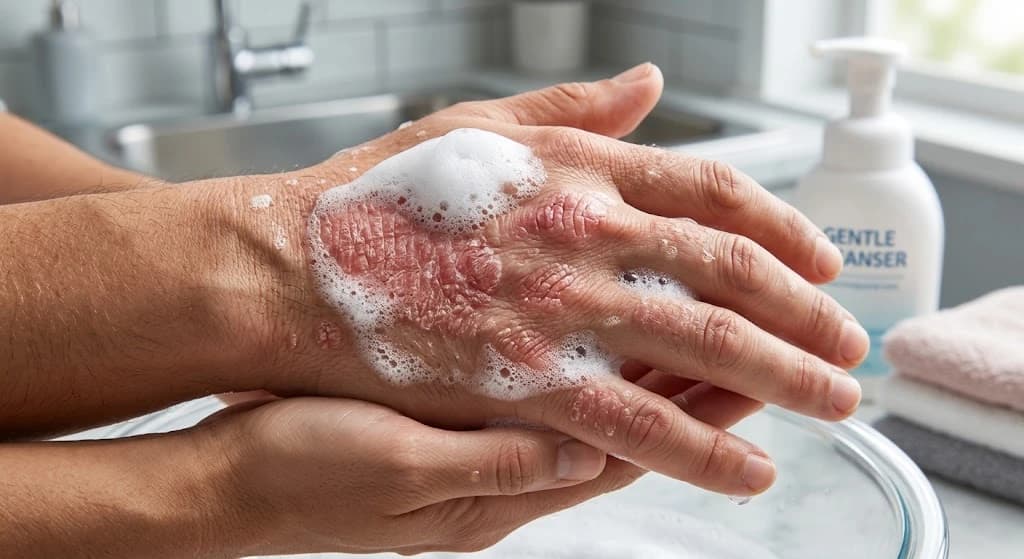
Managing psoriasis isn't just about applying prescription medications when a flare occurs; it's about daily epidermal barrier preservation. A consistent, science-backed skin care routine reduces scaling, relieves itch, improves drug penetration, and helps prevent new plaques triggered by micro-trauma (the Koebner phenomenon).
Here is how to optimize your daily skin care routine using clinically supported strategies.
1. Cleansing: protect the skin barrier
Many standard body washes contain harsh surfactants (like Sodium Lauryl Sulfate) and alkaline pH levels that strip natural lipids, elevate skin pH, and trigger inflammatory cascades.
- Ditch the traditional soap. Switch to synthetic detergent bars (syndets), non-foaming cleansing lotions, or lipid-replenishing wash oils. Look for pH-balanced cleansers (pH 4.5–5.5) that match the skin's natural acidic mantle.
- Keep it warm, not hot. Hot water acts as a vasodilator and strips structural lipids. Stick to lukewarm water.
- Time your baths and showers. Limit bathing to 10–15 minutes. Extended immersion in water without immediate sealing leads to evaporation and worsening dryness.
- Pat, don't rub. Friction from heavy towel scrubbing causes mechanical trauma that can induce new psoriasis lesions via the Koebner phenomenon. Gently pat skin dry, leaving it slightly damp.
2. Bathing additives and keratolytic soaks
Bathing can double as a gentle, non-abrasive method for scale removal (desquamation) when done correctly.
- Colloidal oatmeal. Rich in avenanthramides, colloidal oatmeal baths provide anti-inflammatory and anti-pruritic (anti-itch) benefits by suppressing pro-inflammatory cytokine production in keratinocytes.
- Epsom or Dead Sea salts. Soaking in mineral-rich salts (high in magnesium) for 10–15 minutes helps soften thick, hyperkeratotic scales, making them easier to lift without aggressive picking or scratching.
Crucial rule: never pick, scrape, or peel scales manually. Physical peeling causes micro-bleeding (Auspitz sign) and worsens plaque thickness via Koebnerization.
3. Emollient and moisturizer selection: the dual-action strategy
Clinical studies show that psoriatic skin requires a combination of hydrating agents (humectants) and barrier-sealing agents (occlusives). A landmark study evaluating barrier parameters in psoriasis found that water-based formulations increase hydration, while lipid/petrolatum bases significantly reduce transepidermal water loss (TEWL).
| Product type | Active ingredients | Physiological mechanism | Best for |
|---|---|---|---|
| Humectants | Glycerin, Hyaluronic Acid, Urea (5–10%), Lactic Acid | Attracts water from the dermis into the stratum corneum to restore hydration. | Base layer for hydration; mild scale softening. |
| Occlusives & emollients | Petrolatum, Mineral Oil, Ceramides, Shea Butter | Forms a hydrophobic barrier over the stratum corneum to stop water evaporation. | Thick plaques, nighttime application, cracked areas. |
| Keratolytics | Salicylic Acid (2–5%), High-dose Urea (10–30%) | Breaks down intracellular desmosomes to shed dead keratinocytes and thin thick plaques. | Thick hyperkeratotic plaques (palms, soles, elbows). |
The "Soak and Smear" technique
The single most effective way to moisturize is the Soak and Smear method:
- Wash or soak in lukewarm water.
- Pat dry lightly so the skin remains damp.
- Within 3 minutes, apply a thick emollient (ointment or dense cream) generously over the entire body. This locks in water before it evaporates.
4. How to layer prescribed topicals with moisturizers
One of the most common errors is applying prescription topicals (e.g., corticosteroids, Vitamin D analogs, calcineurin inhibitors) incorrectly alongside daily emollients.
- Timing the layering. If using both a prescription cream and a general moisturizer, apply the medicated cream directly to the active lesion first, wait 15 to 30 minutes for absorption, and then apply the general emollient over top.
- Alternative approach. Applying emollient first can act as a vehicle barrier, slightly reducing the penetration and potency of the steroid. This is sometimes intentionally utilized for sensitive areas like intertriginous folds, but should generally be avoided on thick plaques.
- The Fingertip Unit (FTU). Measure topical steroids using FTUs to prevent over-application and cutaneous atrophy. One FTU is the amount from the distal interphalangeal joint to the tip of an adult index finger, and treats an area equal to two adult hands.
5. Scalp-specific care
The scalp requires distinct formulations because heavy ointments are difficult to wash out of hair.
- Softening scales. Apply mineral oil, salicylic acid oil, or specialized scalp gel to the scalp at night, cover with a shower cap, and wash out in the morning.
- Shampoo technique. Use targeted coal tar or salicylic acid shampoos. Massage into the scalp (not just the hair strands) and leave on for 5 to 10 minutes before rinsing to allow the active ingredients to penetrate the plaque.
- Gentle combing. Use a wide-toothed, soft-bristled brush. Never scrape the scalp with fine combs or fingernails to dislodge scales, as this fuels the Koebner phenomenon.
Summary checklist
- Water: warm, never hot; limit to 10–15 minutes.
- Cleanser: fragrance-free, soap-free syndet or oil wash.
- Drying: gentle patting, no friction.
- Moisturizer: ointment or rich cream applied within 3 minutes of bathing.
- Prescriptions: apply directly to plaques; wait 15–30 minutes before applying general moisturizers.
- Rule #1: never pick, scratch, or scrub scales.
References
Epidermal barrier, hydration and TEWL
- Maroto-Morales, D., Montero-Vilchez, T., & Arias-Santiago, S. (2021). Study of skin barrier function in psoriasis: The impact of emollients. Life, 11(7), 651.
- Purnamawati, S., Indrastuti, N., Danarti, R., & Saefudin, T. (2017). The role of moisturizers in addressing various kinds of dermatitis: A review. Clinical Medicine & Research, 15(3–4), 75–87.
Anti-inflammatory cleansers and bathing
- Ilnytska, O., Kaur, S., Bokhari, S., Sebastiani, K. E., Korotkova, O. I., Sur, R., Southall, M. D., & Flach, C. R. (2016). Colloidal oatmeal (Avena sativa) improves skin barrier through multi-therapy activity. Journal of Drugs in Dermatology, 15(6), 684–690.
- Draelos, Z. D. (2018). The science behind skin care: Cleansers. Journal of Cosmetic Dermatology, 17(1), 8–14.
Keratolytic agents and scale removal
- Fluhr, J. W., Cavallotti, C., & Berardesca, E. (2008). Emollients, moisturizers, and keratolytics in psoriasis. In: Psoriasis and Psoriatic Arthritis, Springer, Berlin, Heidelberg.
- DermNet NZ (2023). Topical therapy for psoriasis.
Koebner phenomenon and micro-trauma
- Ji, Y. Z., & Liu, S. R. (2019). Koebner phenomenon leading to the formation of new psoriatic lesions: Evidences and mechanisms. Bioscience Reports, 39(12), BSR20193266.
Topical application timing and dosing
- UK Medicines and Healthcare products Regulatory Agency (MHRA) / NHS Guidelines.
This post is for general educational purposes and is not a substitute for individual medical advice.