
What Stage Is My HS? Understanding Hurley Stages & What They Mean for Your Treatment
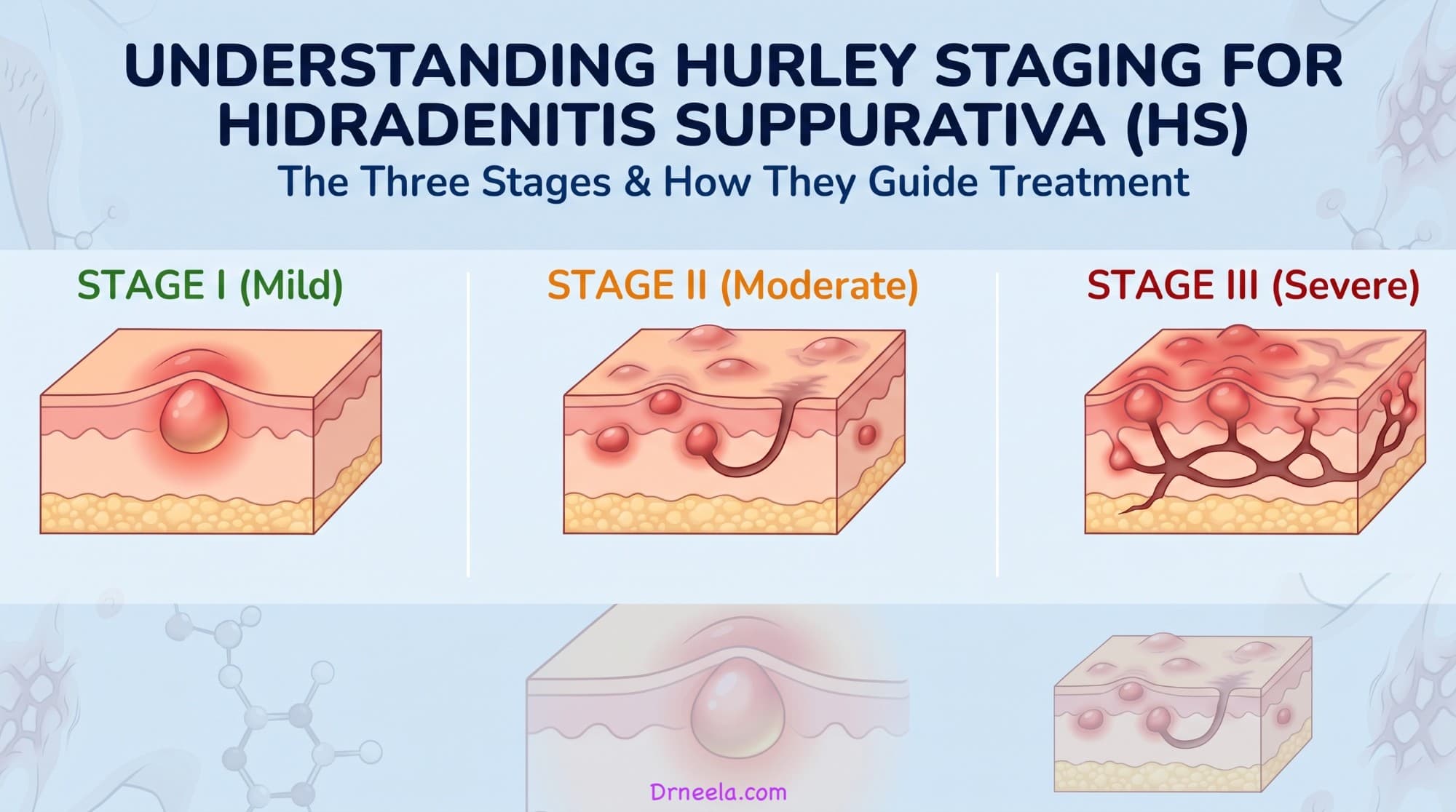
If you've been diagnosed with Hidradenitis Suppurativa (HS), or suspect you might have it, you may have heard your healthcare provider mention "staging." Because HS is a progressive, chronic inflammatory skin condition, doctors use a staging system to describe how advanced the lesions are and to guide treatment decisions.
The most widely used system in clinical practice is the Hurley Staging System. Understanding your Hurley stage can help you better understand your condition, set expectations for treatment, and advocate for your care.
The 3 Hurley Stages of Hidradenitis Suppurativa
The Hurley system classifies HS into three distinct stages based on the presence of scarring and interconnected tunnels (sinus tracts) under the skin.
Hurley Stage I: Mild / Early Stage
- What it looks like: Single or multiple isolated abscesses (painful, inflamed, boil-like bumps) in areas where skin rubs together, such as the armpits, groin, inner thighs, under the breasts, or buttocks.
- Key feature: No sinus tracts (tunnels) beneath the skin and no severe scarring.
- How it feels: Bumps can be tender, painful, and swell up periodically, but they resolve without leaving deep networks under the skin.
- Common misdiagnosis: At this stage, HS is frequently mistaken for recurrent ingrown hairs, folliculitis, or isolated staph infections.
Hurley Stage II: Moderate Stage
- What it looks like: Recurrent abscesses that occur in more than one area or repeatedly in the same location.
- Key feature: Forming sinus tracts (tunnels) and localized scarring.
- How it feels: Lesions may rupture and drain fluid or pus, often with a distinct odor. The skin between individual bumps may feel thickened or cord-like due to subterranean tunneling and scar tissue formation.
Hurley Stage III: Severe / Advanced Stage
- What it looks like: Widespread or diffuse involvement across an entire anatomical area (e.g., the entire axilla/armpit or groin region).
- Key feature: Multiple interconnected sinus tracts and extensive, interconnected scar networks.
- How it feels: Persistent pain, chronic drainage, reduced mobility in affected joints due to tight scar tissue, and frequent flares.
Why Hurley Staging Matters for Treatment
Hurley staging isn't just a label; it serves as a roadmap for targeted treatment:
| Hurley Stage | Typical Focus of Care | Primary Treatment Approaches |
|---|---|---|
| Stage I | Controlling acute inflammation & preventing new flares | Topical antiseptics/clindamycin, short courses of oral antibiotics, warm compresses, friction reduction. |
| Stage II | Halting tunnel formation & clearing persistent lesions | Long-term oral antibiotics, hormonal therapies, targeted biologic injections, minor surgical unroofing (deroofing). |
| Stage III | Managing chronic drainage, severe inflammation & tissue reconstruction | Biologic therapies, oral immunosuppressants, comprehensive pain management, wide surgical excision. |
Important Things to Keep in Mind About Staging
- HS is not always strictly linear: Having Stage I HS does not guarantee it will progress to Stage III, especially with early and effective medical management.
- Different areas can have different stages: You might have Stage I lesions in your armpits but Stage II in your groin.
- Staging measures physical structure, not necessarily pain: A person with Stage I HS can experience intense pain during an acute flare. Your pain and quality of life are always valid regardless of your numerical stage.
When to Talk to Your Doctor
If you notice recurring painful bumps in skin folds, draining lesions, or skin that feels like it has hard tunnels beneath the surface:
- Track your lesions: Note where flares happen, how often they recur in the exact same spot, and whether they leave lasting scars or drainage.
- Ask about your staging: Discuss with your dermatologist or primary care provider what stage your HS appears to be.
- Explore systemic options early: Modern therapies can slow or prevent progression, helping preserve skin health and daily comfort.
Understanding your HS stage gives you a clearer picture of what's happening beneath the surface, and empowers you to work with your healthcare team toward an effective management plan.
This post is for general educational purposes and is not a substitute for individual medical advice.